Managing steady waste streams requires clear equipment specifications rather than municipal delays. In busy retail zones near The Collection at Forsyth or commercial offices along Bethelview Road, unexpected refuse…
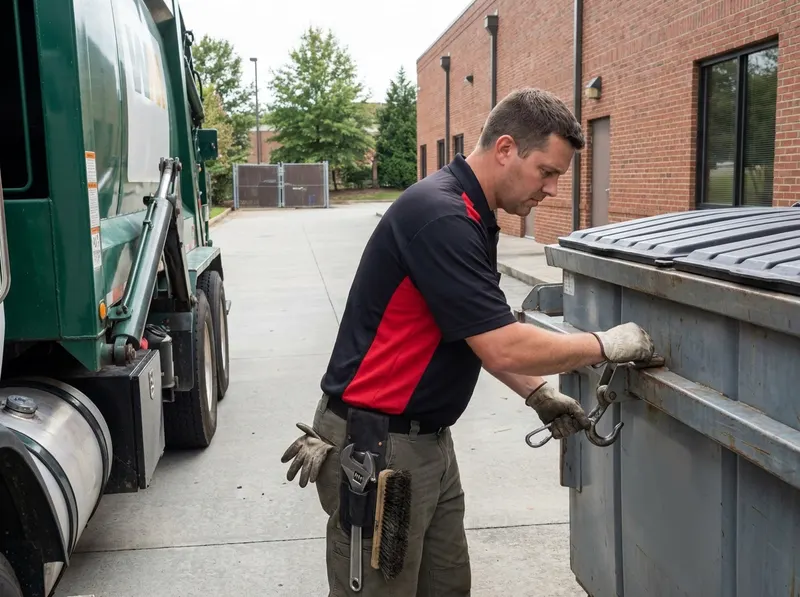
Managing steady waste streams requires clear equipment specifications rather than municipal delays. In busy retail zones near The Collection at Forsyth or commercial offices along Bethelview Road, unexpected refuse pileups violate commercial lease codes and trigger municipal citations. Commercial dumpster and solid waste management provides dedicated rollout containers that prevent loose trash from spilling into common parking areas or loading docks. For high-volume mixed debris, a 30-yard container holds approximately 9 standard pickup truck loads, making it suitable for retail refits or strip-mall warehouse clearouts. A smaller 10-yard bin holds roughly 3 pickup loads, fitting narrow alleys or secondary parking stalls without blocking customer vehicle access.
Property owners balancing heavy renovations against customer traffic face specific operational trade-offs. Choosing an undersized 10-yard container reduces the initial drop footprint on tight commercial asphalt, but frequent swap-outs cause truck congestion and multiple haul fees. Choosing a 40-yard roll-off minimizes daily logistics by accommodating large framing timbers and pallet stacks, yet it demands roughly 22 feet of clear length and a 60-foot pull-off trajectory for the hauler's hoist arm. To protect paved surfaces against the downward pressure of steel rollers, haulers place heavy wooden blocking directly under the contact points before lowering the bin.
Local logistics also vary across residential-adjacent developments such as Vickery, Windermere, and Creekstone Estates, where commercial contractors operate near strict HOA zones. The Forsyth County Department of Environmental Health regulates commercial refuse containment to prevent groundwater runoff into Big Creek and Lake Sidney Lanier watersheds. Wet food waste and hazardous chemicals cannot share roll-offs with dry building materials. Step 1: Assess waste volume to reserve a 10, 20, 30, or 40-yard container. Step 2: Clear an overhead corridor free of utility lines or tree canopies measuring at least 14 feet high. Step 3: Fill the container level with the top rail to maintain highway safety standards during transit to local transfer facilities.
Every job gets a firm, written price after a free on-site visit.
Tell us about your commercial dumpster & solid waste management job in Cumming and we'll send a clear, written quote, usually the same day.
 North Gate Dumpster Rental